Table of Contents
- Core Bow Hunting Setup Fundamentals
- Arrow Selection and Tuning for Consistent Shot Execution
- Is a Modular Bow Hanger Worth It for Saddle Hunting
- Custom 3D Printed Bow Hunting Gear for Mobile Hunters
- Mobile Hunting Setup Organization Strategies
- Sight Systems and Anchor Point Consistency
- Stabilization and Vibration Dampening for Accuracy
- DIY Tuning vs. Professional Shop Work
- Frequently Asked Questions
Last Updated: September 26, 2026
Core Bow Hunting Setup Fundamentals
A solid bow hunting setup starts with understanding how each component affects your shot. The compound bow, draw weight, draw length, arrow spine, and sight system work together as an integrated system. Get one element wrong and accuracy suffers. Get them all right and you're ready to hunt.
Selecting the Right Compound Bow
Your compound bow is the foundation of everything. Modern bows balance speed, accuracy, and forgiveness in ways that matter for actual hunting. The key is matching the bow to your hunting style, not just picking the fastest option.
Draw weight matters more than you'd think. Most hunters choose too much weight early on. A bow you can hold steady at full draw for 30 seconds beats a heavy bow you're fighting to control. For mobile and saddle hunting, where you're climbing and repositioning, a lighter draw weight (55-65 pounds) gives you better control and less fatigue during the critical moment.
Draw length precision is non-negotiable. Even half an inch off changes your anchor point, your sight picture, and your consistency. Get measured by a professional at a local shop. This isn't something to estimate.
Draw Weight and Draw Length Optimization
The relationship between draw weight and draw length determines your kinetic energy and momentum downrange. Higher draw weight generates more energy, but only if you can execute consistently. A hunter who shoots a 60-pound bow accurately beats one who struggles with 70 pounds.
Start by understanding your physical capability. Can you draw your bow while wearing your hunting clothes? Can you hold at full draw without shaking? If the answer is no, the weight is too high. You'll fatigue quickly in the tree, and fatigue destroys accuracy.
Tuning your setup for your specific draw length ensures your arrow spine matches your bow's characteristics. Spine refers to the arrow's stiffness. Too stiff and the arrow won't flex properly around the bow's riser. Too soft and it'll oscillate wildly. Getting this right is what separates consistent shots from erratic ones.
Arrow Selection and Tuning for Consistent Shot Execution
Your arrow is the projectile. Everything about your bow setup only matters if the arrow flies true. Arrow selection and tuning aren't afterthoughts, they're central to a functional bow hunting setup.
Arrow Spine and Broadhead Flight
Arrow spine is measured in hundredths of an inch of deflection under a standard load. For compound bows, typical spines range from .340 to .500. Your bow's draw weight, draw length, and arrow rest configuration all influence which spine you need.
Broadhead flight depends on arrow spine matching your setup. A mismatch creates paradox, the arrow bends around the riser, but if the bend is wrong, the broadhead flies at an angle. This is why arrow selection feels so technical: it directly affects whether your broadhead hits where your sight pins say it should.
Most hunters overthink this. Use a spine chart from your arrow manufacturer. Match your draw weight, draw length, and bow type. Order arrows in that spine. Done.
Paper Tuning and Walk-Back Tuning Methods
Paper tuning reveals how your arrow flies immediately after leaving the bow. You shoot through a sheet of paper and observe the tear pattern. The goal is a bullet hole, arrow and broadhead create one clean hole.
Here's what most guides miss: paper tuning only works if your rest is already close to center shot. If your arrow rest is way off, paper tuning will mislead you. Start with a rough center shot adjustment first.
Walk-back tuning is the field version. You shoot at a target from increasing distances and observe where arrows impact. If your arrow drifts left as distance increases, your arrow is too stiff. Too soft and it drifts right. This method works because it accounts for your actual shot cycle and release, not just the mechanical setup.
Both methods matter. Paper tuning is fast and precise. Walk-back tuning confirms your actual field performance.
Is a Modular Bow Hanger Worth It for Saddle Hunting
Modular gear has become standard for mobile hunters. The question isn't whether you need organization, it's whether a modular system justifies the cost and complexity versus fixed alternatives.
Modular vs. Fixed Hanger Systems
A fixed bow hanger bolts to your saddle or platform in one location. It's simple, lightweight, and works. A modular system uses gear straps or molle loops, letting you move accessories around as your needs change.
Modular wins for hunters who experiment. You can test different configurations, move your release holster, adjust your rope caddy position. Fixed wins for hunters who've already dialed in their setup and want zero maintenance.
The real advantage of modular is flexibility. If you hunt different tree diameters, carry different gear in different seasons, or share equipment with hunting partners, modular adapts. The Bow Hanger - Gear Strap for Saddle Hunting from 3D Hunting Solutions fits up to 1-inch gear straps and integrates with standard molle systems. This means you're not locked into one configuration.

Gear Strap Integration and Tree Compatibility
Gear straps create a standardized attachment point. Most modern saddle systems and climbing gear use molle or similar standards. When your bow hanger, release holster, and rope caddy all attach to the same strap system, you're building a cohesive mobile hunting setup.
Tree compatibility matters more than manufacturers admit. Not all trees are the same diameter.
Custom 3D Printed Bow Hunting Gear for Mobile Hunters
3D printing changed what's possible for mobile hunting gear. Custom-printed accessories let you solve problems that off-the-shelf gear can't address. The durability question is legitimate, and the answer matters.
Release Holsters and Stabilizer Mounts
Your release aid needs to be accessible but secure. A holster that falls off mid-climb is worse than no holster. A holster that's hard to draw from wastes critical seconds.
Durability and Field Performance
The skepticism about 3D-printed gear is understandable. Will it crack? Will it fail when you need it most?
Mobile Hunting Setup Organization Strategies
Mobile hunting means carrying everything on your body. Every ounce matters. Every piece of gear needs a place. Organization isn't luxury, it's functional necessity.
Gear Hoists and Platform Caddies
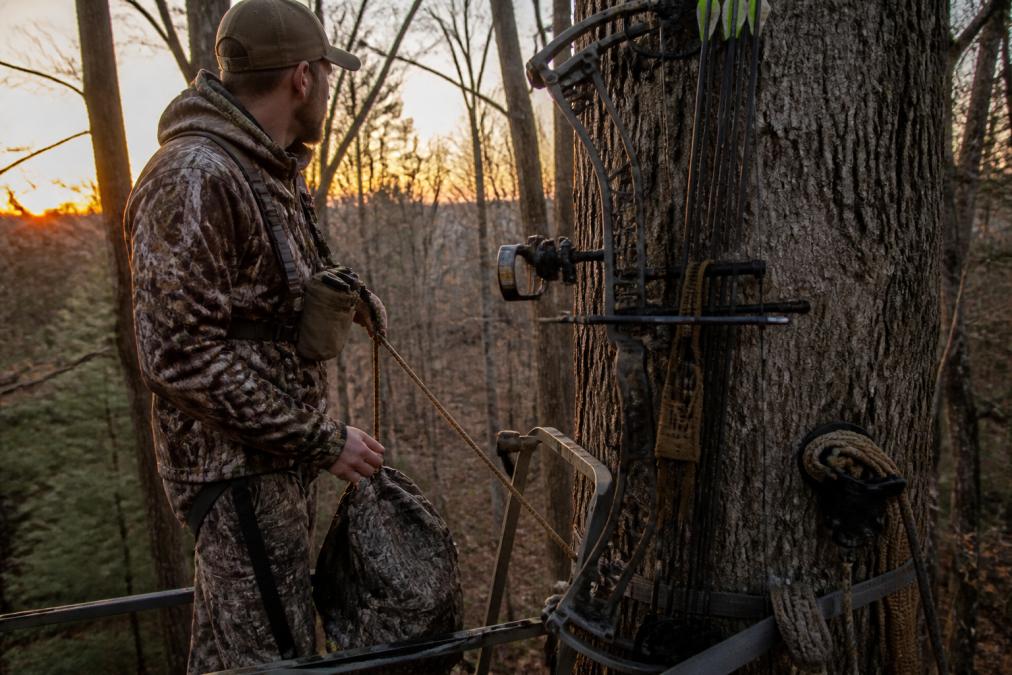
A gear hoist solves the problem of getting your pack and bow into the tree without exhausting yourself. You hoist gear up after you climb, which means you're not fighting weight on the way up.
Rope Management and Tether Clips
Loose rope causes problems. It catches on branches, creates noise, and adds bulk. Rope management is about keeping everything in place during movement.
Sight Systems and Anchor Point Consistency
Your sight system is how you translate distance into accuracy. Pin gap, peep sight alignment, and anchor point consistency determine whether your sight picture is reliable.
Pin Gap and Peep Sight Alignment
Pin gap refers to the distance between your sight pins. Wider gaps mean more precision at specific distances but less room for error. Tighter gaps give you more forgiveness but less precision at extreme distances.
Stabilization and Vibration Dampening for Accuracy
Vibration after release affects arrow flight. Stabilizers reduce vibration, which improves consistency. The longer and heavier your stabilizer, the more vibration it dampens, but there's a point where added weight hurts more than it helps.
Stabilizer Length and Weight Configuration
A 10-inch stabilizer is standard for hunting. It's long enough to reduce vibration without being cumbersome in tight spaces. Weight distribution matters, a 4-ounce stabilizer is better than an 8-ounce one for mobile hunting.
Bow Balance and Shot Cycle Smoothness
Bow balance affects your shot cycle, the entire motion from drawing to release. A well-balanced bow draws smoothly and holds steadily. An unbalanced bow creates micro-movements that throw off your accuracy.
DIY Tuning vs. Professional Shop Work
You can tune your own bow. Many hunters do. The question is whether the time investment and potential mistakes justify the savings.
Frequently Asked Questions
What makes custom 3D printed bow hunting gear better than mass-produced alternatives?
Custom 3D printed bow hunting gear is engineered for specific use cases, saddle hunting, mobile setups, and backcountry conditions, rather than generic applications. 3D Hunting Solutions designs and prints accessories in-house, allowing rapid iteration based on real-world field testing. Materials like TPU and PETG offer durability comparable to traditional polymers while enabling lighter weight and modular designs. This precision manufacturing eliminates unnecessary bulk and ensures tight tolerances that improve gear integration and reliability during critical moments in the field.
Is a modular bow hanger worth it for saddle hunting?
Yes, a modular bow hanger is worth it for saddle hunting because it reduces setup time and eliminates the need for multiple fixed hangers across different tree diameters and gear configurations. Modular designs like the Bow Hanger - Gear Strap for Saddle Hunting ($14.00) attach to existing molle gear straps, keeping your bow secure without adding bulk or weight. The 3.5-inch gap accommodates most compound bows, and the ability to integrate with your existing gear strap means faster transitions between trees and more stable bow positioning during the hunt.
How do I organize my mobile hunting setup to minimize weight and maximize accessibility?
Organize your mobile hunting setup using a modular approach: mount your bow on a gear strap hanger, store your release in a stabilizer holster (like the Archery Release Stabilizer Holster at $17.00), and use a gear hoist (Multi Spool Gear Hoist, $13.00) to pull up heavier items after climbing. Rope management is critical, use the Saddle Bridge and Rope Caddy ($6.00) to keep your bridge and extra rope secured and out of the way during ascent. Tether clips like the T-REX ($13.00) prevent rope slack and keep your ascent smooth. This layered approach distributes weight, keeps gear accessible, and reduces fumbling in the tree.
Can custom 3D printed accessories integrate with my existing bow setup?
Yes, most custom 3D printed accessories from 3D Hunting Solutions integrate with existing setups. Release holsters mount via stabilizer threads or bridge lock slots, working with popular brands like Scott, Ultraview, and Mathews. Bow hangers fit standard molle gear straps and amsteel rope systems. Platform caddies accommodate multiple platform models (specify your model at checkout). If your specific gear configuration isn't covered, 3D Hunting Solutions offers custom design services to ensure compatibility with your exact bow, platform, and accessory combination.