Table of Contents
- Start With a Weight Budget, Not a Gear List
- How Much Should a Hunting Pack Weigh?
- Your Backcountry Hunting Packing List, Built by Category
- Hunting Pack Organization: Load Order and Quick Access
- Personalize the Load: Season, Terrain, and Hunt Duration
- Five-Day Backcountry Hunting Checklist and Final Pre-Trip Checks
- Conclusion: Pack Once, Hunt Harder
- Frequently Asked Questions
Last Updated: October 12, 2026
Start With a Weight Budget, Not a Gear List
Most hunters build a pile of gear first, then discover it weighs too much. That order is backwards. Learning how to pack for backcountry hunting starts with a number, not a shopping list.
At 3D Hunting Solutions, we build gear for mobile and backcountry hunters, so we think about pack weight constantly. The math is simple: you carry everything you bring, and every ounce rides on your hips and shoulders for miles.
So set your base weight first. Base weight is everything in your pack except food, water, and fuel. Those three items change daily. Your base weight should not.
Set Your Base Weight Target Before You Shop
A common approach is to aim for a base weight between 15 and 20 pounds for a multi-day hunt. Hunters who carry more specialized gear often land higher. Ultralight setups can go lower.
The exact number matters less than knowing yours before you buy. A kitchen scale tells you the truth your hands cannot feel.
How Much Should a Hunting Pack Weigh?
There is no single right answer, but there is a useful rule. A loaded pack for a multi-day backpack hunt often lands between 35 and 50 pounds on day one, depending on food and water.
That range gives you a working target. If your loaded pack creeps past it, something in the load needs to change.
Weighing Every Item: The Kitchen Scale Method
Weigh each item on a kitchen scale and write the number down. This takes an evening. It changes how you pack forever.
- Shelter and sleep system
- Clothing layers
- Water filter and storage
- Food and cooking gear
- First aid and repair kit
- Optics, calls, and navigation
Add the numbers. The total is your real base weight. Now you can see what to cut.
Your Backcountry Hunting Packing List, Built by Category
A backcountry hunting packing list works best when you build it by category, not by memory. Categories keep you from forgetting critical items and from packing duplicates.
Here are the core groups every multi-day hunt needs.
Shelter, Sleep System, and Clothing Layers
Your shelter and sleep system carry the biggest weight. A lightweight tent or tarp, a sleeping bag rated for the season, and a sleeping pad form the core.
Clothing layers should follow a system, not a pile:
- Base layer to move sweat away from skin
- Insulating layer for cold mornings and glassing sessions
- Outer shell for wind and rain
- Boot gaiters for wet grass and snow
- Padded shorts for long sits in a saddle
Pack layers you can add or remove. A single heavy jacket is less useful than three lighter pieces.
Water, Food, and Cooking Equipment
Water is heavy, so plan around sources, not bottles. Carry a filter and a small amount of storage. Refill as you go.
Food planning is where most hunters underpack or overpack. Count your days and add one. For a five-day hunt, plan roughly five to six days of calories.
- High-calorie bars and nut mixes
- Dehydrated meals for dinners
- A small stove and fuel canister
- One pot and a long spoon
Keep your cooking system small. You are boiling water, not cooking a feast.
First Aid, Repair, and Navigation
Your first aid kit should cover blisters and trauma. Blister pads and Leukotape fix the most common trail problem before it ends your hunt.
Add a small repair kit for your bow and pack. A few spare parts can save a trip.
For navigation, carry a map, a compass, and a GPS or phone app. For communication, a satellite messenger is worth its weight when you have no cell signal.
Hunting Pack Organization: Load Order and Quick Access
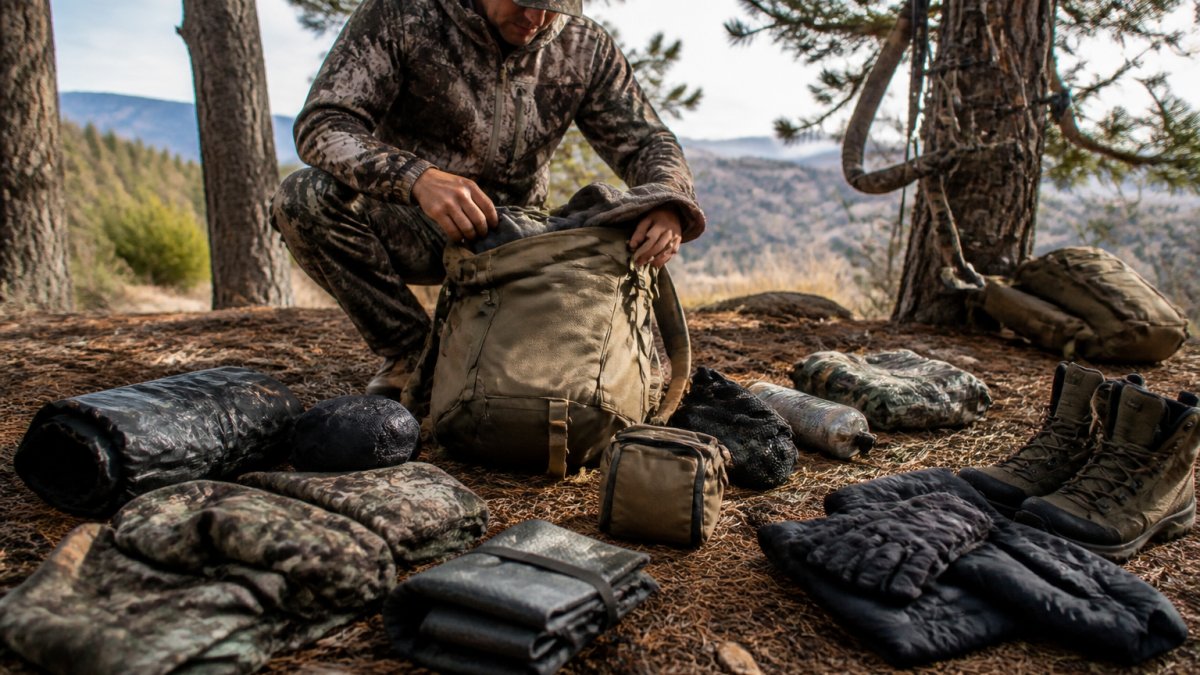
Hunting pack organization comes down to one rule: heavy items close to your spine, frequently used gear within reach, and quiet access for everything.
Load your pack in this order:
- Sleep system and shelter at the bottom, where you rarely reach.
- Heavy items like food and water against your back, centered.
- Bulkier layers around the heavy core to fill dead space.
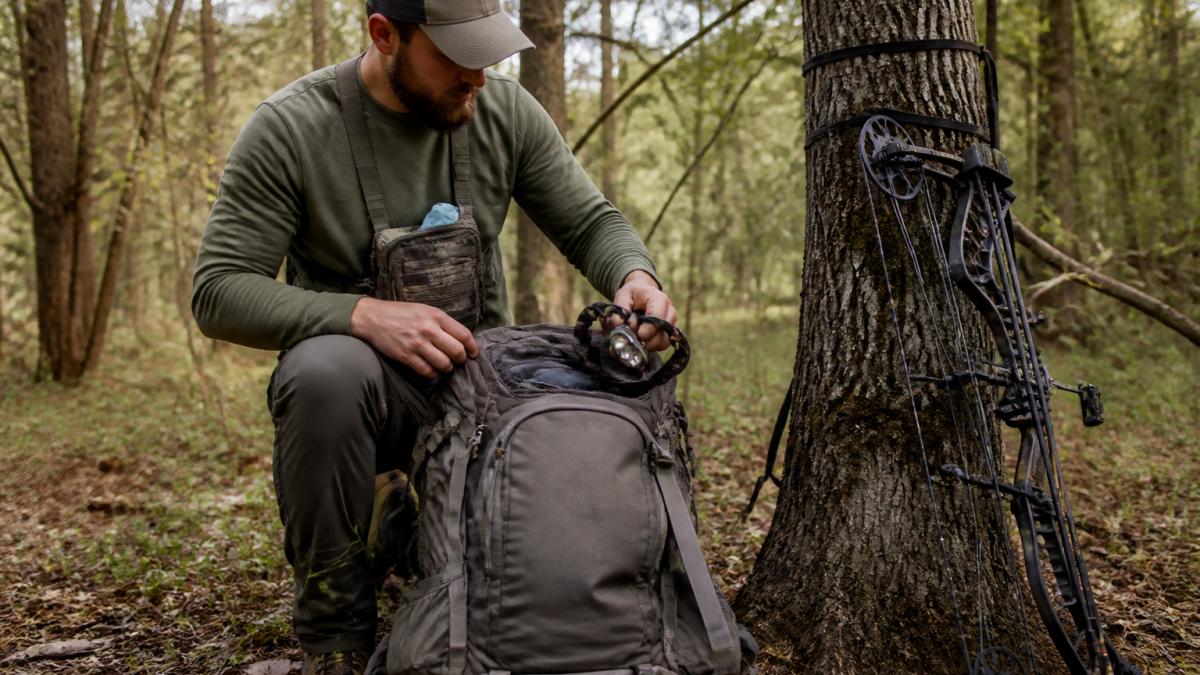
- Frequently used gear in top and side pockets.
- Optics, calls, and tag in a chest or lid pouch.
Pack soft items tight and compress them. Loose gear shifts, and shifting gear makes noise and burns energy.
Personalize the Load: Season, Terrain, and Hunt Duration
Most packing lists assume one hunt. Real hunts vary, and the load should change with them. The gap most guides leave open is the decision rule: what actually comes out of the pack, and what goes in, when conditions shift. Weight management often dictates that you debone a deer in the field to streamline your pack for the long trek back to the trailhead.
Use three dials, season, terrain, and duration, and adjust the same base load for each.
Season: What Changes From Early to Late
Season drives insulation, water, and bug pressure more than any other factor.
- Early season (warm, high sun): Swap the puffy for a light fleece, carry more water capacity because sources may be dry, and add a head net and permethrin-treated layer. Drop the heavy gloves.
- Mid-season (mixed): Keep one insulating layer, one shell, and a light puffy for glassing. This is the most forgiving window, most hunters can run their standard base weight here.
- Late season (cold, short days): Add a heavier puffy, a second pair of gloves, hand warmers, extra fuel for longer stove runs, and a warmer bag rating. Cold also means you burn more calories, so add food, not just layers.
A useful rule: for every 20°F drop in expected overnight low, add roughly one pound of insulation across bag, pad, and worn layers. That is not exact, but it forces you to think in weight, not vibes.
Terrain: Steep vs. Flat Changes the Math
Terrain changes how much weight your legs can actually move, and how often you can resupply water.
- Steep, broken country: Trekking poles earn their weight. Cut food volume by choosing calorie-dense items, and plan water around known sources rather than carrying a full day. Expect to move slower, so plan fewer miles per day.
- Rolling or flat country: You can carry more water and a heavier shelter without paying as much. You rarely need to, but the penalty for overpacking is smaller.
- Timber vs. open: Timber hunts reward quiet access and compact gear. Open-country hunts reward optics and a tripod, which add weight you cannot cut.
Duration: The One-Night Rule
The single biggest packing mistake is treating a two-night hunt like a five-night hunt.
- Overnight to two nights: Cut the stove if fire restrictions allow, or carry one dehydrated meal and cold calories. Drop the repair kit to the essentials for your bow or rifle only.
- Three to five nights: This is the standard backcountry load. Full cook system, full food, full first aid.
- Six nights or more: Add resupply planning. Either cache food, plan a mid-trip town stop, or accept a heavier pack on day one and lighter pack after the cache. Long hunts also justify a second headlamp and a spare battery bank.
The Archery and Rifle Adjustment
Weapon choice changes the repair kit, not the whole load.
- Archery: A spare string, serving thread, a small allen set, and a spare rest or D-loop material. A damaged string or rest can end a hunt you spent months planning.
- Rifle: A small tool kit for scope rings and action screws, plus a bore snake. Less to break, but a loose scope ring ruins a shot.
Five-Day Backcountry Hunting Checklist and Final Pre-Trip Checks
A five-day backcountry hunting checklist should fit on one page. Run it the night before you leave, then run it again at the trailhead.
- Shelter, sleeping bag, and pad packed
- Clothing layers for the forecast
- Water filter and storage
- Five to six days of food
- Stove, fuel, and pot
- First aid and trauma kit
- Blister pads and Leukotape
- Bow repair kit and spare parts
- Map, compass, and GPS
- Satellite messenger, charged
- Headlamp and spare batteries
- Game bags and meat care items
- Optics, tripod, and calls
Check your pack weight one last time. If it climbed since your last trip, find out why before you start walking.
Conclusion: Pack Once, Hunt Harder
Packing for a backcountry hunt is a skill you build over seasons. The hunters who suffer least are the ones who weigh their gear, set a base weight, and pack the same way every trip.
At 3D Hunting Solutions, we build gear that makes that system easier. Our Pack Rat carries your platform and sticks with a center channel that keeps the load locked and quiet, and it doubles as a knee pad in the tree. The Tree Hugger keeps your essentials organized and within reach, with quiet pocket linings and molle loops for customization. Both are designed and 3D printed in-house, then tested in real hunting conditions.

Get started with 3D Hunting Solutions and build a pack that carries lighter and hunts harder.
Frequently Asked Questions
What should I pack for a backcountry hunting trip?
A complete backcountry hunting packing list covers shelter, sleep system, clothing layers, water filtration, food and a cooking system, first aid and blister care, navigation and a communication device, a repair kit, and game bags for meat care. Weigh every item before it goes in. A five-day load usually lands between 40 and 55 pounds total, including food, water, and your bow or rifle. Build the list by category so nothing critical gets left behind.
How much should a hunting pack weigh for backcountry hunting?
For a multi-day backcountry hunt, aim for a base weight (everything except food, water, and consumables) between 20 and 30 pounds. Add roughly 1.5 to 2 pounds of food per day and about 2 pounds per liter of water. A five-day trip typically totals 40 to 55 pounds at the trailhead. If your pack exceeds that, cut ounces from shelter, sleep system, and cooking gear first, since those categories carry the most replaceable weight.
How do I organize a hunting pack for a multi-day trip?
Use a three-zone system. Heavy items like your shelter, food, and water go in the middle of the pack, close to your spine, to keep the load stable. Bulky but light gear such as your sleeping bag goes at the bottom. Frequently used items, including your rangefinder, calls, and snacks, go in hip-belt pockets or the top lid. Keep everything in stuff sacks so it stays quiet and compresses. A modular pack such as the Tree Hugger ($79.99) lets you pre-pack essentials and strap the whole unit to the tree once you're in position.
How should I pack meat out after a backcountry hunt?
Quarter the animal, place each quarter in a breathable game bag, and hang it in shade to cool before you load up. Distribute meat weight across the pack frame rather than in one lump, and keep the heaviest load close to your spine. A five-day pack that already weighs 45 pounds can jump to 100 pounds or more with a full elk quarter, so plan your pack-out in trips and know your route before the shot. Carry extra game bags and paracord every trip.