
Last Updated: October 24, 2026
Quick Summary
A bow hanger keeps your bow off the ground and within arm's reach, mounted at roughly chest height on your support side so you can grab it without leaning or shifting weight. Choose a gear strap, Amsteel, or MOLLE attachment based on your setup, then load test it with your fully rigged bow before the hunt.
- Mount the hanger below eye level and angle it slightly outward so the bow hangs free of the tree.
- Most hunting bow hangers are rated around 25 pounds, well above a 5- to 9-pound compound bow.
- A 3.5-inch gap lets the bow hang without the string or cables contacting the hook.
- A bow hanger keeps your bow in reach during the hunt; a bow stand is for storage or ground setups.
- Re-check the strap and hook after the first few hangs, since new webbing and rope can stretch.
Table of Contents
- Why a Bow Hanger Belongs in Every Mobile Hunting Setup
- Bow Hanger Placement: Where to Put It for Quiet, Quick Access
- Saddle Hunting Bow Hanger Options: Straps, Amsteel, and MOLLE
- Bow Hanger Weight Capacity: What It Holds and Why It Matters
- Bow Hanger vs. Bow Stand: Matching the Tool to the Job
- Step-by-Step Installation and Secure Mounting Checks
- Shop Bow Hangers Built for Mobile Hunters
- Frequently Asked Questions
Why a Bow Hanger Belongs in Every Mobile Hunting Setup
A bow hanger is a simple piece of gear that keeps your bow off the ground, out of your lap, and within reach the moment a deer steps into range. At 3D Hunting Solutions, we build bow hangers for mobile and saddle hunters because we got tired of balancing a bow on a platform edge at the worst possible moment.
That is the whole case for a dedicated bow hanger, and it holds up in every hunting setup we have seen. Tree stand hunters need one. Saddle hunters need one. Ground hunters sitting in a blind need one too.
Below, we break down placement, strap and Amsteel options, weight limits, and how a bow hanger differs from a bow stand, so you can pick the right tool and mount it once, correctly.
Bow Hanger Placement: Where to Put It for Quiet, Quick Access
Place your bow hanger within arm's reach of your shoulder, roughly level with your chest when seated or hanging in a saddle. That position lets you grab the grip without leaning, twisting, or shifting your weight. Movement is what gives a hunter away, and a well-placed bow hanger removes most of it.
The common mistake is mounting the hanger too far forward or too high. Both force a reach that rocks the stand or swings the saddle.
A few placement rules we follow:
- Mount on the support side opposite your draw hand so the bow clears your body on the lift
- Keep the hanger below eye level so you can see the bow in peripheral vision
- Leave clearance for the cams and limbs so nothing contacts bark on the grab
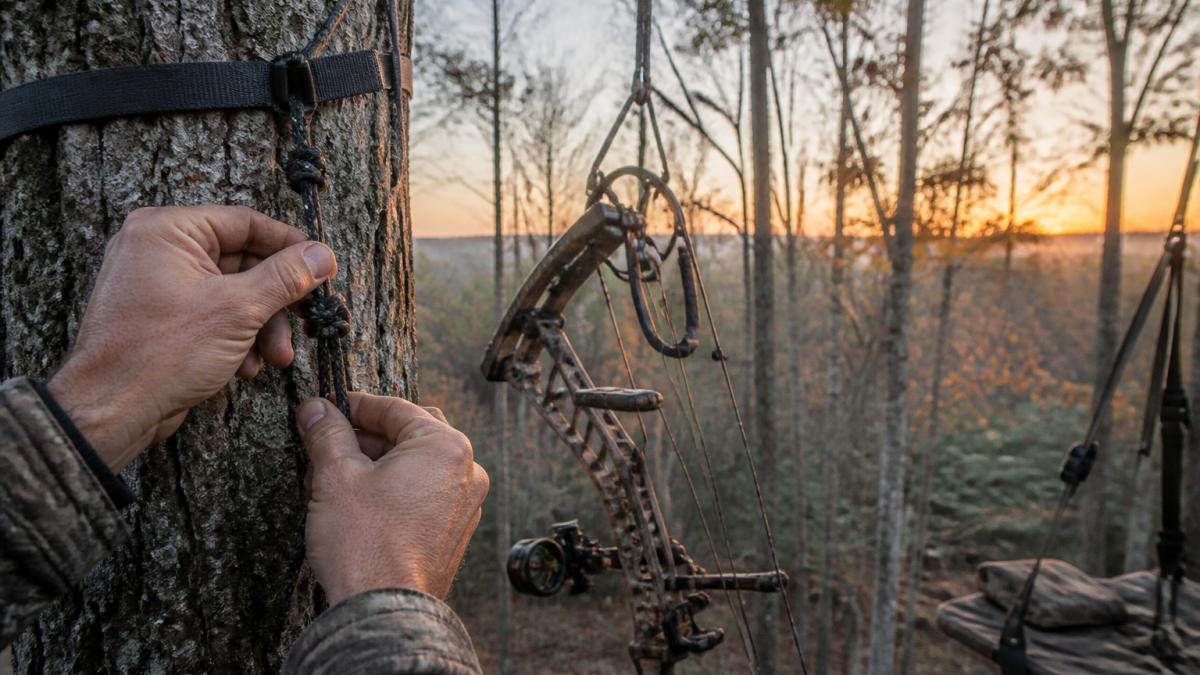
- Angle the hanger slightly outward so the bow hangs free, not against the tree
Positioning on Tree Stands and Saddle Setups
On a tree stand, mount the hanger to the trunk or a rail at chest height, offset from your shooting lane. On a saddle setup, hang it from your gear strap or platform so it rides with you as you shift position. Saddle hunters move more than stand hunters, so the hanger needs to travel with the setup, not stay fixed to one spot.
For a full walkthrough of attaching your bow to a saddle at the right height, see our guide on how to attach a bow to saddle.
Saddle Hunting Bow Hanger Options: Straps, Amsteel, and MOLLE
Saddle hunting bow hanger designs fall into three attachment families: gear strap, Amsteel or rope, and MOLLE. Each solves a different problem, and the right choice depends on what your setup already uses.
Gear strap hangers clip onto a strap up to 1 inch wide and work with MOLLE, HYS, and standard daisy-chain webbing. They are the most universal option and the easiest to move between trees.
Amsteel hangers use a rope or daisy chain to wrap the tree, giving you a flexible, packable attachment that adds almost no weight to your kit.
MOLLE hangers lock directly into a platform or pack's MOLLE webbing, so the hanger stays with the platform rather than the tree.
Our own line covers all three. For a deeper comparison of saddle gear hanger setups, load limits, and picks, see our Saddle Hunting Gear Hanger guide. The Amsteel Bow Hanger uses a 3.5-inch gap. The Bow Hanger - Gear Strap for Saddle Hunting fits up to a 1-inch strap, and the Split Limb Bow Hanger - Gear Strap for Saddle Hunting is built for bows with split limbs.


Bow Hanger Weight Capacity: What It Holds and Why It Matters
Most bow hangers sold for hunting are rated around 25 pounds, which comfortably covers a fully rigged compound bow. A typical hunting compound with sight, rest, stabilizer, quiver, and five arrows usually lands somewhere in the 5- to 9-pound range, so the rated capacity is not really about the bow's static weight.
That distinction matters because a hanger can pass a static hang test and still fail in the field. When you snatch a bow off a hook, you briefly apply more force than the bow weighs, and that force concentrates at the hook gap and the attachment point.
Check four things before you trust a hanger:
- Stated capacity vs. real load. Confirm the rating accounts for a loaded quiver and accessories, not just a bare bow. If the manufacturer only lists a bare-bow weight, assume you have less margin than the number suggests.
- Material and thickness at the hook or gap. Stress concentrates where the bow contacts the hanger. A thin hook or a narrow gap is the first place to look for flex.
- Attachment point. A strong hook on a weak strap, a worn Amsteel splice, or a loose MOLLE clip still fails. The weakest link sets the real capacity.
- Gap size and contact. A 3.5-inch gap, like the one on our hangers, gives the bow room to hang without the string or cables contacting the hook. That protects your bow's contact points and keeps the draw clean.
A simple field check: hang your fully rigged bow, then pull down firmly and slightly outward, the way you would on a grab. Watch the hook, the strap, and the attachment for any movement. If anything shifts, tighten it or move to a stronger mounting point before you trust it with your bow.
Bow Hanger vs. Bow Stand: Matching the Tool to the Job
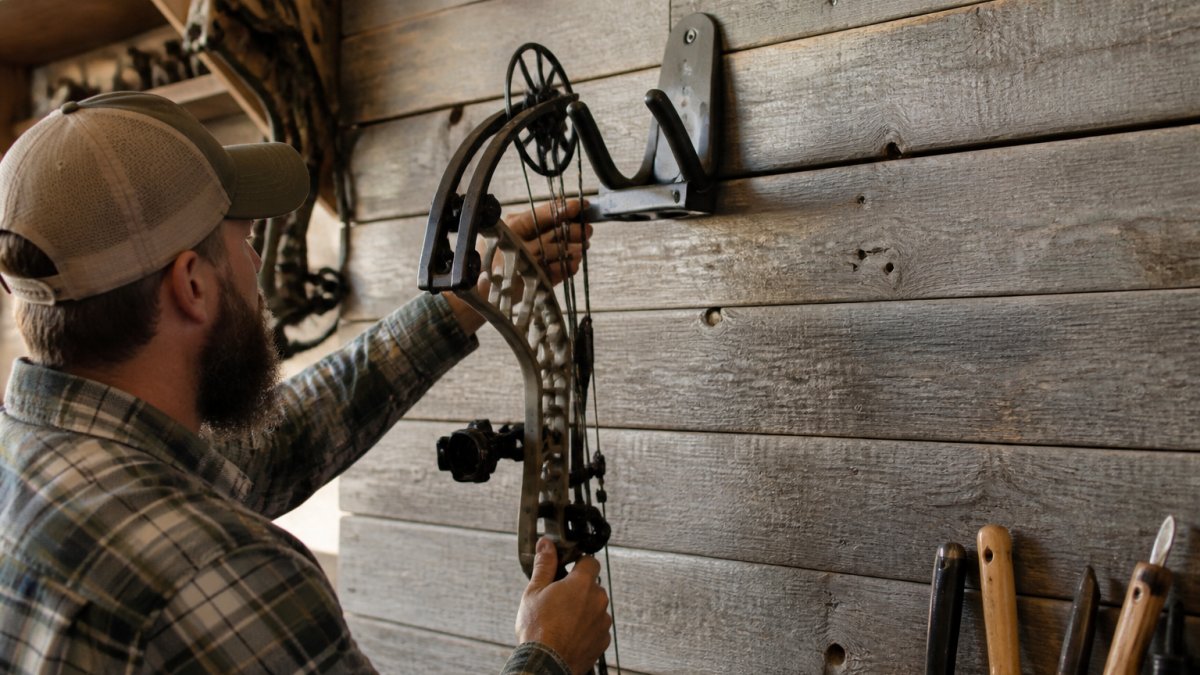
A bow hanger keeps a bow within reach while you are actively hunting; a bow stand holds a bow upright for storage, maintenance, or ground setups. They are not interchangeable, and buying the wrong one wastes money.
| Feature | Bow Hanger | Bow Stand |
|---|---|---|
| Primary use | Bow within reach during the hunt | Storage, maintenance, ground setup |
| Mounting | Tree, gear strap, MOLLE, Amsteel | Ground or flat surface |
| Portability | Packs flat, near-zero weight | Bulkier, stays at camp or home |
| Best for | Tree stand and saddle hunters | Home storage and ground hunting |
If your hunt happens in a tree or a saddle, a bow hanger is the tool. If you need a stable rest for tuning or a ground blind, a stand makes more sense. Many hunters carry both.
Step-by-Step Installation and Secure Mounting Checks
Installing a bow hanger takes about two minutes and one careful check. The steps below cover the three common attachment types, gear strap, Amsteel or rope, and MOLLE, plus the safety checks that keep the hanger from failing when you need it most.
- Choose the spot. Chest height, support-side, clear of your draw path. On a tree stand, mount to the trunk or a rail offset from your shooting lane. On a saddle setup, hang it from your gear strap or platform so it rides with you as you shift position.
- Inspect the mounting surface. Look for loose bark, soft or punky wood, cracks, or a rail that flexes. A hanger is only as secure as what it attaches to. On a tree, avoid dead limbs and rotten spots; on a stand, confirm the rail or bracket is solid.
- Set the attachment. Wrap the Amsteel or thread the gear strap around the trunk or rail, then cinch it tight. For MOLLE, weave the hanger through the webbing and confirm it locks. For screw-in or bolt-on mounts, use the included hardware and seat it fully.
- Mount the hanger. Clip the hanger to the strap or MOLLE webbing and confirm the gap faces your draw side.
- Load test. Hang the bow and pull down firmly to check for slip or flex. This is the step most hunters skip, and it is the one that catches a loose strap or a weak mounting point before the hunt.
- Check clearance. Confirm the cams, limbs, and string clear the bark and the hook. Angle the hanger slightly outward so the bow hangs free, not against the tree.
Watch out for three common failure points: a strap that loosens as it settles, a hook that rotates under load, and a mounting surface that was never solid to begin with. Re-check the strap and hook after the first few hangs, since new webbing and rope can stretch slightly.
Shop Bow Hangers Built for Mobile Hunters
The right bow hanger disappears into your setup: light, quiet, and always where your hand expects it. We design and 3D print every hanger in-house, then test it in the field before it ships, because gear that fails 20 feet up is not gear worth selling.
Our hangers start at $10.00 for the split-limb gear strap model, with the Amsteel and strap versions at $14.00. Each one is built to fit the straps and platforms mobile hunters already run.

Frequently Asked Questions
What is a bow hanger used for?
A bow hanger keeps your bow off your lap and within reach while you're in a tree stand or saddle. Instead of balancing the bow on a rail or holding it for hours, you hang it on a hook so both hands stay free for calls, rangefinders, or adjusting gear. The right bow hanger also keeps the bow protected from contact with the tree and reduces the movement needed when a shot opportunity appears.
How much weight can a bow hanger hold?
Weight capacity depends on the hanger and how it's mounted. Most hunting bows and crossbows fall well under 25 pounds, and quality hangers are built with a secure hold and stable support for that range. Always check the manufacturer's stated capacity and confirm your strap or mount is tight before hanging. A hanger rated for your bow weight, attached to a secure gear strap, gives you reliable support through the whole sit.
Can you use a bow hanger with a tree saddle?
Yes. Saddle hunters typically use a bow hanger that attaches to a gear strap, Amsteel rope, or MOLLE webbing rather than screwing into the tree. Options like the Amsteel Bow Hanger and the Gear Strap Bow Hanger from 3D Hunting Solutions are built for this, with a 3.5-inch gap and a fit for straps up to 1 inch. This keeps your bow within reach without damaging the tree or adding bulky hardware.
What is the difference between a bow hanger and a bow stand?
A bow hanger is a small hook or bracket that holds your bow in the tree while you hunt, keeping it within reach for a quick, quiet shot. A bow stand or rack is a larger freestanding or wall-mounted unit used for storage at home, in a shop, or at the range. Mobile hunters carry a hanger; storage setups use a stand. Some hunters use both, hanging in the field and storing on a rack between trips.
Your setup is only as good as the gear that holds it together. At 3D Hunting Solutions, we build purpose-made bow hangers and accessories for saddle and mobile hunters, designed and 3D printed in-house with field-tested durability. Browse the Amsteel and gear strap hangers, pick the attachment that matches your platform, and get your bow within quiet, quick reach. Get started with 3D Hunting Solutions and hunt with gear that holds.
