
Table of Contents
- Best Bow Accessories for Saddle Hunters: A Complete Gear Guide
- Quick Comparison: Top Bow Accessories for Saddle Hunting
- Best Bow Hanger for Saddle Hunting: Amsteel vs. Gear Strap vs. Split Limb
- Quiver Caddies and Hangers: Keeping Arrows Within Reach
- Saddle Hunting Gear Organization: Building an Efficient Setup
- Mobile Hunting Setup Tips: Cutting Weight Without Cutting Corners
- Accessory Compatibility and Attachment Points
- Conclusion: Build Your Perfect Saddle Hunting Kit
- Frequently Asked Questions
Last Updated: September 9, 2026
Best Bow Accessories for Saddle Hunters: A Complete Gear Guide
Saddle hunting has reshaped how mobile hunters approach the whitetail woods, trading bulky tree stands for a minimalist setup that weighs ounces and sets up in minutes. But that stripped-down platform creates a specific problem: where do you put your bow and quiver when you're suspended from a tether with no platform to lean them against? The answer lies in purpose-built best bow accessories for saddle hunters, which solve the dual challenge of keeping your equipment silent, secure, and within arm's reach at draw.
This guide breaks down the gear that actually earns its place on your saddle. We'll cover bow hangers, quiver caddies, and organization strategies that keep your setup quiet and efficient, then close with a compatibility framework so you buy once and buy right.
The core insight most guides miss is that saddle hunting accessories aren't just about holding gear; they're about weight-to-utility ratio. Every ounce you add to your saddle bag is an ounce you carry to the tree and back. A good accessory must justify its weight through reliability, quick deployment, and seamless integration with your existing platform. Below, we'll show you exactly how to evaluate each piece of gear through that lens.
A saddle hunting setup is only as good as its weakest attachment point. Whether you're 20 feet up a pine or 30 feet up a gnarly oak, your bow needs a secure home that won't rattle, slip, or interfere with your shot. Bow accessories like hangers and quiver caddies are the connective tissue between your gear and the tree, and choosing the right ones determines whether your hunt ends in a clean shot or a dropped bow.
Quick Comparison: Top Bow Accessories for Saddle Hunting
Before diving into the details, here's a snapshot of the primary accessory categories and what each offers. This comparison helps you match the right tool to your specific bow and climbing setup.
| Accessory | Mounting Style | Best For | Price |
|---|---|---|---|
| Amsteel Bow Hanger | Rope/Amsteel loop | Hunters using daisy chain or rope attachments | $14.00 |
| Gear Strap Bow Hanger | Molle/HYS/Gear strap | Modular setups with 1" straps | $14.00 |
| Split Limb Bow Hanger | Split limb contact | Bows with split limb designs | $10.00 |
| Quiver Caddy | Treestand screw-on | Fixed treestand hunters | $14.00 |
| Clip-on Quiver Hanger | Gear strap slide | Detachable quivers with rods | $14.00 |
Each of these categories serves a distinct purpose. Bow hangers secure your primary weapon; quiver caddies keep arrows within reach without adding noise. The right combination depends on your bow's limb configuration and whether you prefer rope-based or strap-based attachment systems.

Best Bow Hanger for Saddle Hunting: Amsteel vs. Gear Strap vs. Split Limb
The bow hanger is the single most critical accessory in your saddle setup. It holds your bow at the exact height and angle you need for a silent draw, and it must do so without damaging your limbs or adding noise. Three mounting styles dominate the market, and each excels in different scenarios.

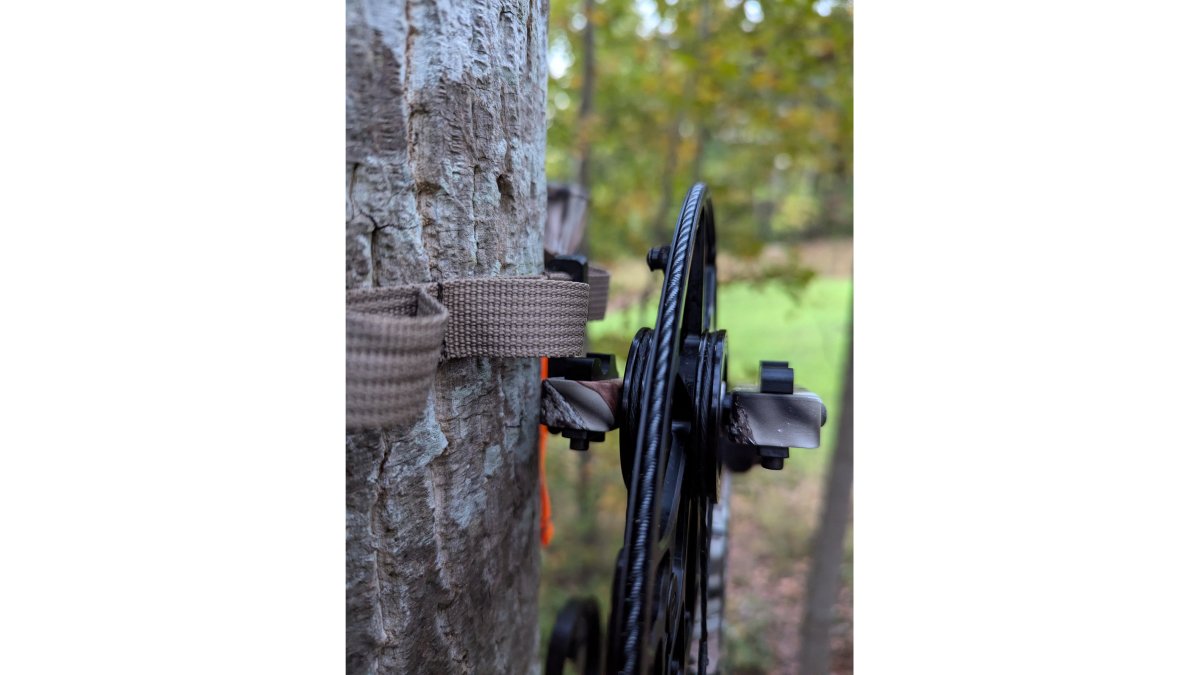
The gap on most quality hangers is 3.5 inches, which accommodates standard bow limbs and risers while keeping the bow secure (archerytrade.org). The real decision comes down to how you attach the hanger to your tree or saddle.
Amsteel Bow Hanger
The Amsteel Bow Hanger uses a rope or Amsteel loop for attachment, making it ideal for hunters who prefer daisy chains or who want a hanger that works with any tree diameter. At $14.00, it offers a straightforward, reliable solution that doesn't depend on strap compatibility. The open hook design allows for quick one-handed bow placement, which matters when you're settling into position with limited mobility.
What most guides miss about Amsteel hangers is their versatility with odd-shaped trees. Because the rope cinches around the trunk rather than relying on a fixed strap, you can position the hanger exactly where you need it, even on trees with significant taper or branches.
Gear Strap Bow Hanger
The Bow Hanger - Gear Strap for Saddle Hunting slides onto a Molle, HYS, or standard gear strap up to 1 inch wide. This design integrates directly with modular saddle systems, letting you position the hanger anywhere along your strap without additional hardware. It's the best choice for hunters who have already built a strap-based platform and want accessories that clip in and out quickly.
The tradeoff is that you need a strap system in place. If you're running a minimalist rope-only setup, a gear strap hanger adds complexity you might not want.
Split Limb Bow Hanger
Split Limb Bow Hangers , available at $10.00, are designed specifically for bows with split limb configurations. Instead of hooking around the riser, these hangers cradle the space between the limbs, which can be more stable on certain bow models. They work with both gear straps and Amsteel rope, giving you flexibility depending on your platform.

Quiver Caddies and Hangers: Keeping Arrows Within Reach
Your quiver holds your shot opportunity, and fumbling for it at full draw is a recipe for a blown opportunity. Quiver caddies and hangers position your arrows at a fixed, predictable location so your hand goes exactly where it needs to go every time. essential hog hunting gear.
The mounting style matters as much as the quiver itself. Some caddies screw directly into a treestand, while others slide onto gear straps or clip onto quiver rods. Your choice depends on whether you hunt primarily from a saddle, a treestand, or both.
Treestand Archery Quiver Caddy
The Treestand Archery Quiver Caddy at $14.00 is designed for hunters who use fixed treestands. It holds your quiver horizontally or vertically and includes two screw holes for bolting directly to the stand. This provides the most stable mounting option, ideal for hunters who leave stands set up for the season.
CBE Archery Quiver Caddy
For hunters running a CBE quiver, the CBE Archery Quiver Caddy at $9.00 lets the quiver clamp slide over the post, just like it would on your bow. The caddy fits any 1-inch or smaller gear strap, making it a lightweight addition to a saddle setup. At under $10, it's an inexpensive way to keep arrows accessible without adding bulk.
Clip-on Archery Quiver Hanger
The Clip-on Archery Quiver Hanger at $14.00 is the most versatile option for saddle hunters. It slides onto your gear strap while you're in the tree and clips securely onto the quiver rod. The two-piece design, held together by a stainless steel screw, provides a secure grip that won't loosen during the hunt. This is the best choice for hunters who use detachable quivers and want to remove them from the bow while maintaining quick access.
Tight Spot Archery Quiver Caddy
The Tight Spot Archery Quiver Caddy at $14.00 is engineered for Tight Spot quiver clamps. It allows rotation into four distinct positions, so you can angle your arrows exactly where you want them. The rear teeth on the clip grip the tree firmly, keeping your gear steady even on windy days (fs.usda.gov). Four mounting options, including 1-inch and 3/4-inch Molle straps, ensure compatibility with most saddle systems.
Saddle Hunting Gear Organization: Building an Efficient Setup
Saddle hunting gear organization is what separates a smooth hunt from a frustrating one. When you're hanging from a tether, every piece of gear needs a designated home that you can reach without looking. The goal is to minimize movement and noise while maximizing efficiency.
A well-organized saddle setup follows a simple logic: items you use most frequently go closest to your dominant hand, and items you use rarely go in your pack. Your bow hanger sits at chest height on your off-hand side. Your quiver caddy positions arrows on your draw-hand side for a natural grab. Everything else, calls, rangefinder, release, tucks into pouches that don't interfere with your draw path.
Consider a modular approach using Molle-compatible accessories. This lets you reconfigure your setup for different hunts, adding a quiver caddy for archery season or stripping down to just a bow hanger for a quick evening sit.
Mobile Hunting Setup Tips: Cutting Weight Without Cutting Corners
Mobile hunting setup tips often focus on shaving ounces from your climbing system, but your accessory choices matter just as much. A saddle, platform, and climbing sticks might weigh 10 pounds, but add a heavy bow hanger, multiple quiver caddies, and unnecessary pouches, and you've quietly added several pounds to your load (saddlehunter.com).
The weight-to-utility ratio is your guiding principle. A $10 split limb bow hanger that weighs 2 ounces and holds your bow securely has an excellent ratio. A multi-tool that attaches to your saddle but weighs 8 ounces and duplicates tools already in your pack has a poor one.
Prioritize accessories that serve multiple functions. A quiver caddy that works with both your saddle and your treestand eliminates the need for separate gear. A bow hanger that attaches to any strap, rather than a proprietary system, ensures compatibility if you switch saddles later.
Accessory Compatibility and Attachment Points
The most technically sound accessory is useless if it doesn't fit your setup. Accessory compatibility comes down to three variables: strap width, attachment style, and quiver type. Understanding these before you buy prevents the frustration of gear that doesn't integrate.
Standard gear straps are 1 inch wide, and most accessories from 3D Hunting Solutions accommodate this size. Molle systems use a similar width but have specific weave patterns that require compatible hooks. Amsteel and rope attachments bypass strap compatibility entirely, offering the broadest range of fit.
Quiver compatibility is more specific. CBE quivers have a distinct clamp design, Tight Spot quivers use their own mounting system, and detachable quivers with rods need a clip-style hanger. Knowing your quiver's mounting mechanism is the first step in choosing a caddy.
| Accessory Category | Attachment Point | Compatible With | Key Consideration |
|---|---|---|---|
| Bow Hanger | Gear strap (1") | Most saddle systems | Check strap width |
| Bow Hanger | Amsteel/rope | Any tree | Most versatile |
| Quiver Caddy | Screw-on | Fixed treestands | Requires drilling |
| Quiver Caddy | Gear strap | Molle/HYS systems | Slide-on design |
| Quiver Hanger | Clip-on | Detachable quivers | Matches quiver rod |
Conclusion: Build Your Perfect Saddle Hunting Kit
Building the right accessory kit for saddle hunting is a process of elimination, not accumulation. Start with a reliable bow hanger that matches your bow's limb configuration and your preferred attachment style. Add a quiver caddy that keeps arrows within reach without adding noise. Then refine your organization based on what you actually use in the field.
The best bow accessories for saddle hunters share common traits: they're lightweight, they attach silently, and they integrate with your existing setup. 3D Hunting Solutions designs every accessory with these principles in mind, 3D printing each piece in-house in the USA and field-testing it in real hunting conditions. From Amsteel bow hangers to Tight Spot quiver caddies, the focus is on durability and practical functionality that improves your time in the tree.
Get started with 3D Hunting Solutions and build a saddle kit that keeps your bow silent, your arrows reachable, and your focus on the shot.
Frequently Asked Questions
What is the best bow hanger for saddle hunting?
The best bow hanger for saddle hunting depends on your bow's limb design and your strap setup. For standard limbs, a closed or open bow hanger with a 3.5-inch gap works well on most compound bows. For split-limb bows, choose a dedicated split-limb hanger to avoid interference. Consider whether you mount on an Amsteel rope or a 1-inch gear strap, then pick a hanger that matches your existing saddle attachments.
How do you keep your bow accessible while saddle hunting?
Keep your bow accessible by mounting a bow hanger on your gear strap or tether at chest height. Position the hanger on the side of your dominant hand so you can grab the bow without shifting your body. A hanger with a wide gap makes one-handed retrieval and replacement easier, which matters when a shot opportunity appears suddenly.
What are the best ways to organize gear on a hunting saddle?
Use a molle or HYS strap system to create attachment points across your saddle. Add purpose-built caddies for your quiver, bow hanger, and other tools so everything has a fixed place. Organize gear by frequency of use: items you need for the shot should be at chest level, while less-used items can sit lower. This approach keeps your setup quiet and reduces movement.
How do 3D printed accessories improve saddle hunting setups?
3D printed accessories improve saddle hunting by offering purpose-built designs that fit specific gear, such as quiver clamps from CBE, Tight Spot, or Mathews. They attach directly to molle webbing or gear straps without adding bulk. Since they are printed in-house in the USA from durable materials, they provide a reliable, lightweight alternative to generic metal hooks that may not match your saddle's attachment system.