
Table of Contents
- What Advanced Gear for Mobile Saddle Hunters Actually Changes
- Lightweight Climbing Sticks for Saddle Hunting: What Matters
- Best Backpack for Mobile Bowhunters: Load-Bearing Packs That Work
- 3D Printed Hunting Accessories Built for Saddle Setups
- Tether, Rope, and Suspension Safety for Mobile Saddle Hunters
- Budget-to-Pro Upgrade Paths and DIY Modifications
- Frequently Asked Questions
Last Updated: September 22, 2026
What Advanced Gear for Mobile Saddle Hunters Actually Changes
Advanced gear for mobile saddle hunters is equipment engineered to reduce weight, cut setup time, and keep every component quiet and secure during rapid deployment. The payoff is simple: less fumbling in the dark, more hunts per season. At 3D Hunting Solutions, we build accessories around that exact problem.
Lightweight Climbing Sticks for Saddle Hunting: What Matters
Weight and packability decide whether you hunt a spot twice or skip it. A stick set that carries tight against your platform beats a lighter set that rattles and snags. But the numbers behind that trade-off are what separate a system that works from one that just looks good on a spec sheet.
Stick Weight, Packability, and Attachment Methods
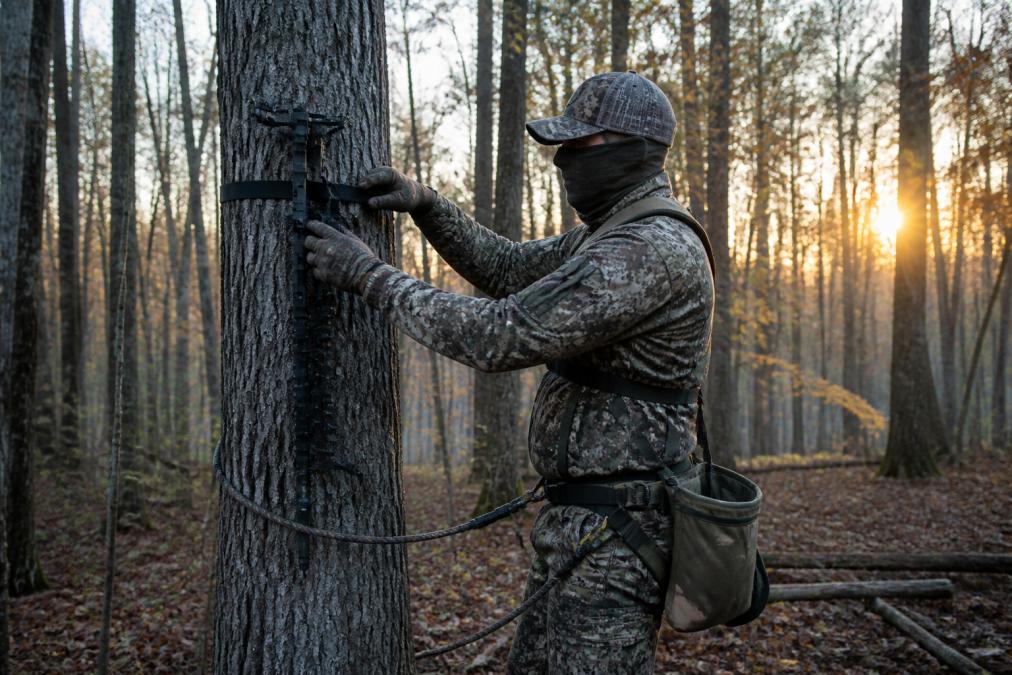
Most mobile stick sets land between 1.5 and 2.5 lbs per stick, and a three-stick setup typically runs 5 to 8 lbs total before aiders. That range is where the real decisions live, because shaving a half-pound per stick rarely changes your hunt, but a stick that won't nest flat against its neighbor will cost you every single setup.
Three specs matter more than advertised weight:
- Stacked profile. Sticks that nest flat against each other and lock to your platform eliminate the hang-ups that cost you time and noise. Look for a stacked depth under about 2 inches per stick when nested; anything thicker starts catching brush on the walk in.
- Step spacing. A 15-inch step interval is the common baseline for hunters around 5'10" to 6'0". Shorter intervals mean more steps per stick and more weight; longer intervals mean fewer steps but a bigger reach that gets awkward with a loaded pack.
- Attachment method. A secure MOLLE-based connection keeps sticks vertical and centered on your hike in. Bungee-and-hook systems are faster to deploy but shift under load, which is exactly when you don't want movement.
One-Sticking and Rappel Setups
One-sticking trades multiple sticks for a single stick and a controlled rappel down. It rewards hunters who practice the technique and punishes those who don't. The appeal is obvious: one stick instead of three, a fraction of the pack weight, and a descent that's faster than climbing down step by step.
Aider Integration and Climb Height
Aiders are the cheapest way to add climb height without adding a stick. A three-step aider on a single stick can add roughly 3 feet of reach, which often means one fewer stick in the pack. The trade-off is that aiders demand more balance and more attention to foot placement, especially in the dark.
Best Backpack for Mobile Bowhunters: Load-Bearing Packs That Work
The best backpack for mobile bowhunters is one that carries your platform and sticks as a single locked unit, distributes load across your hips, and doubles as usable gear once you're in the tree.
Platform and Stick Carry Configurations
Center-channel platform carry keeps weight close to your spine and stops the side-to-side swing that wears you out on long approaches. Vertical stick carry removes the snag points that catch brush.
| Setup | Best For | Weight | Key Feature |
|---|---|---|---|
| Pack Rat | Platform + stick carry | 2.1 lbs | Center-channel platform lock |
| Pack Rat XL | Larger platforms up to 18.5" | 2.6 lbs | Scaled center channel |
| Tree Hugger | Gear organization at height | 1 lb 13 oz | Straps directly to tree |
| Tree Hugger Mini | Lighter loads | 1 lb 8 oz | 2" narrower profile |
3D Printed Hunting Accessories Built for Saddle Setups
Purpose-built 3D printed hunting accessories solve the small problems that add up to big noise and wasted motion in the field. The category exists because generic hardware wasn't designed around saddle geometry.
Tether Management, Bridge Control, and Platform Caddies
Rope that swings free catches on limbs and gives away your position. The Saddle Bridge and Rope Caddy ($6.00) holds your bridge or extra rope against your belt or MOLLE loops, available in five sizes and compatible with 8mm-11mm rope.

Tether, Rope, and Suspension Safety for Mobile Saddle Hunters
Safety gear is the one category where "good enough" isn't a standard. Suspension trauma, the dangerous pooling of blood in the legs during prolonged hanging, is the risk most hunters underestimate. But the gap most guides leave wide open is what happens after the season, the inspection and retirement work that determines whether your rope is still safe next fall.
Inspection Routines and Suspension Trauma Prevention
Inspect ropes and tethers before every hunt. Run your hands along the full length, checking for glazing, flat spots, and abrasion. Retire any rope that shows core damage, no exceptions.
Post-season inspection checklist:
- Rope sheath. Run the full length through your hands under light tension. Glazing (shiny, stiff, melted-looking spots), fuzziness, and flat spots all indicate sheath damage. Any of them means retire the rope.
- Core check. If the sheath slides freely over the core or the rope feels unusually soft in one section, the core may be compromised. Retire it, you cannot visually confirm core integrity on a covered rope.
- Carabiners. Check the gate action, the gate spring tension, and the wear groove where the rope rides. A gate that doesn't snap closed cleanly or a groove deep enough to catch a fingernail means replace it. Also check for corrosion around the pin and any deformation at the spine.
- Stitching and webbing. On any sewn sling, bridge, or lineman's belt, inspect every stitch line for broken or pulled threads, and check the webbing for UV fading, stiffness, or abrasion. Faded webbing has lost strength even if it looks intact.
- Metal hardware. Check every screw link, quick link, and platform attachment point for galling, bent gates, or stripped threads.
Suspension Trauma: What Actually Happens
Suspension trauma, also called harness hang syndrome, happens when a motionless hang cuts off venous return from the legs. Blood pools, the heart has less to pump, and consciousness can fade faster than most hunters expect. The risk isn't the fall; it's the minutes after a fall when you're hanging and can't get weight off your legs.
Three habits reduce the risk:
- Keep hangs short. If you're hanging motionless, you're at risk. Shift weight, move your legs, and get your feet on something solid as fast as you can.
- Carry a foot loop or aider. A simple loop you can step into takes weight off your legs and buys you time to think and act.
- Know your self-rescue. Practice getting from a hang back to your stick, platform, or a controlled descent, on the ground, before you need it.
Retirement Criteria: When to Replace, Not Repair
Rope and hardware are consumables, not lifetime purchases. The honest retirement triggers are:
- Any core damage, glazing, or flat spots on a rope
- A carabiner with a compromised gate, deep wear groove, or corrosion
- Webbing with broken stitches, UV fading, or stiffness
- Any component that took a shock load, even once
Budget-to-Pro Upgrade Paths and DIY Modifications
Build in stages rather than buying everything at once. Start with a load-bearing pack and a reliable tether clip, then add platform and rope management as your budget allows.

| Stage | Add This | Why |
|---|---|---|
| Budget | Rope Caddy ($6) | Stops rope snags and noise |
| Mid | Platform Caddy ($16) | Frees both hands while climbing |
| Pro | Pack Rat ($139.99) | Full platform and stick carry system |
| Complete | Tree Hugger ($79.99) | Organized, quiet gear at height |
Frequently Asked Questions
What are the essential components of an advanced mobile saddle hunting setup?
A complete setup includes a tree saddle, tether and lineman's belt, climbing method such as lightweight sticks or one-sticking, a platform for standing shots, and a load-bearing pack. Add a bow hanger, rope management accessories, and a platform caddy to keep gear organized. Each component should work together so setup time stays under 15 minutes and nothing rattles during the climb.
How do 3D printed hunting accessories improve performance for saddle hunters?
3D printed accessories solve specific problems: tether clips stop rope slippage during ascent, bridge caddies keep ropes out of the way while walking and climbing, and platform caddies let you carry your platform hands-free. Because they are printed in-house, they can be sized to your exact platform model and rope diameter. Materials like PETG and TPU hold up to cold temperatures and repeated field use.
What features should I look for in lightweight climbing sticks for saddle hunting?
Prioritize packability and attachment method. Sticks with a compact stacking profile and single-row molle compatibility carry better on a pack. Look for double-step designs that reduce the number of sticks needed, and check that the standoff fits trees with heavy bark or unusual diameters. Weight per stick matters, but how the sticks attach to your pack matters just as much for quiet, fast setups.
What is the best backpack for mobile bowhunters who also saddle hunt?
The best pack carries your platform and sticks securely without shifting, doubles as a knee pad or gear organizer once you're in the tree, and keeps essentials accessible without digging. Look for molle loops for customization, waterproof material, and a design that lets you strap gear directly to the tree once you're set. Modular systems that pair a main pack with a smaller gear pack give you flexibility for both short sits and multi-day trips.
How can I reduce the weight of my mobile hunting pack without sacrificing durability?
Start by eliminating duplicate tools and consolidating accessories. Use purpose-built clips and caddies instead of generic carabiners that add bulk. Choose packs made from 600D waterproof polyester, which balances weight and abrasion resistance. Swap metal hardware for high-strength polymer where the load allows it, and verify that every item you carry serves at least two purposes in the field.
What are the latest innovations in saddle hunting tether and climbing systems?
Recent developments include tether clips that lock rope in place and eliminate slippage during ascent, integrated eye attachments for staging rappel ropes, and modular caddies that keep bridges and ropes organized. One-sticking continues to gain traction for hunters who want to climb with a single stick and rappel down. Rope management accessories now work with 8mm to 11mm ropes, covering most tether and lineman's belt diameters.